


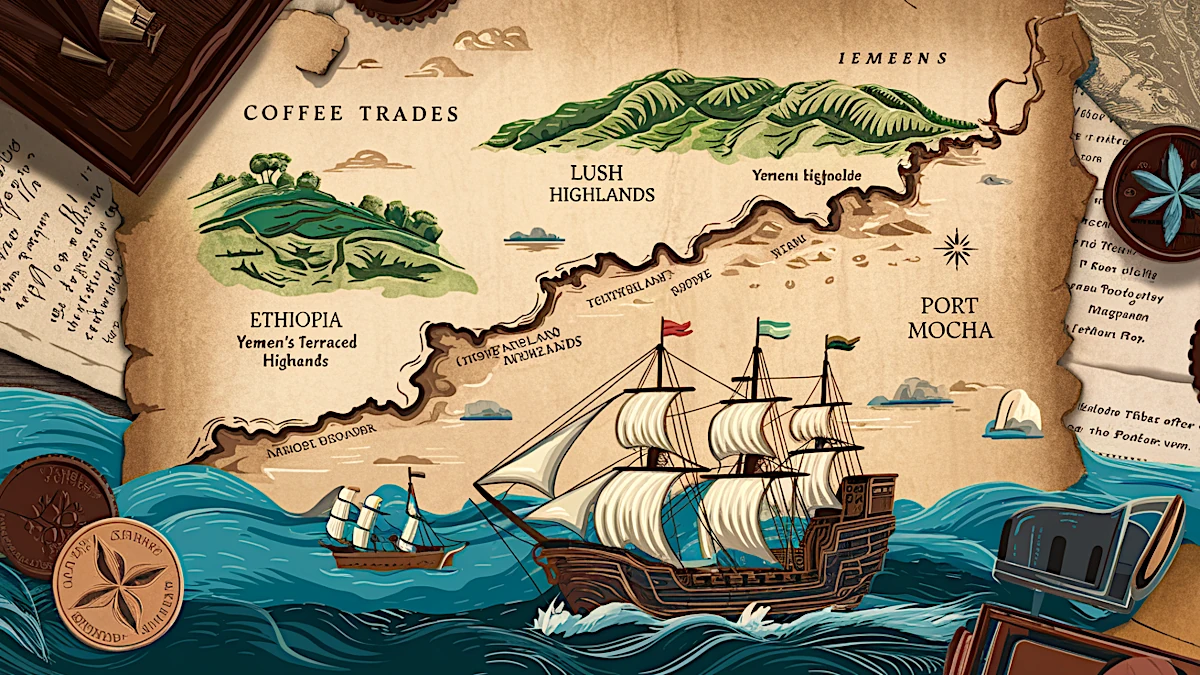
The Port of Mocha, Yemen, holds a significant place in history as a pivotal hub in the global coffee trade. Known for its strategic location and bustling marketplace, Mocha connected the coffee-rich regions of Yemen and Ethiopia to the rest of the world. This article explores the rich history of the port, its role in shaping global coffee culture, and the enduring legacy it left behind.
Table of Contents
The Origins of the Coffee Trade
The story of coffee begins with its discovery and cultivation in the highlands of Ethiopia and its expansion into Yemen, where the beans became a valuable commodity.
Ethiopian Coffee Roots
Ethiopia is widely regarded as the birthplace of coffee, home to the wild coffee forests of Kaffa and Sidamo. According to legend, Kaldi, a goat herder, observed his goats’ energetic behavior after eating red coffee cherries, leading to the discovery of coffee’s stimulating effects.
- Wild coffee was initially consumed in Ethiopia through rudimentary preparations.
- By the 15th century, trade routes carried Ethiopian beans to the Arabian Peninsula.
- Ethiopian coffee became a sought-after good, laying the foundation for the coffee trade.
Yemen: The First Commercial Coffee Cultivator
Yemen played a crucial role in transitioning coffee from wild harvests to cultivated agriculture. The country’s fertile terraced farms provided ideal conditions for growing coffee.
- Yemeni farmers were the first to cultivate coffee commercially, creating a new chapter in coffee’s history.
- Coffee from Yemen became renowned for its unique flavor profile, shaped by the region’s arid climate and traditional processing methods.
- The beans were shipped to Mocha, the central hub for exporting coffee worldwide.
Mocha Port: A Coffee Trade Powerhouse
The Port of Mocha, located on Yemen’s Red Sea coast, became synonymous with coffee during the 17th and 18th centuries. Its geographic advantages and vibrant trade networks made it a linchpin in the global coffee trade.
Mocha’s Rise as a Trade Hub
- Mocha’s location along the Red Sea made it a critical link between Africa, the Middle East, and Europe.
- By the late 17th century, Mocha was thriving as a marketplace, exporting vast quantities of Yemeni coffee.
- Coffee was transported via camel caravans to Mocha and shipped to destinations as far as Europe, Persia, and the Ottoman Empire.
Key Players in Mocha’s Coffee Economy
- Merchants from India and the Middle East, particularly Banyan traders, dominated the coffee trade.
- These traders established sophisticated networks, handling logistics and finances that kept the coffee flowing to international markets.
- Mocha’s reputation for high-quality coffee elevated its status in the global market, attracting European buyers.
The Decline of Mocha’s Influence
While Mocha thrived as a coffee hub for centuries, shifts in trade patterns and competition from colonial plantations led to its decline.
Changing Trade Routes
- By the 18th century, European colonial powers began cultivating coffee in Java, the Caribbean, and Central America, reducing reliance on Yemeni coffee.
- The rise of direct shipping routes bypassed traditional ports like Mocha.
Economic and Cultural Impact
- The declining prominence of Mocha had a significant economic impact on Yemeni coffee farmers, who faced reduced demand and global competition.
- However, Mocha’s name became ingrained in coffee culture, symbolizing quality and tradition.
The Enduring Legacy of Mocha Coffee
Although Mocha’s role as a trade hub diminished, its legacy endures in the coffee world.
Modern Appreciation for Yemeni Coffee
Yemeni coffee is celebrated for its distinctive, complex flavors and remains a luxury item in the specialty coffee market. Enthusiasts treasure Yemeni beans for their historical significance and artisanal cultivation methods.
Symbolism of Mocha in Coffee Culture
The term “Mocha” has become synonymous with high-quality coffee, influencing everything from coffee labels to modern café culture. Its name is often used to denote rich, chocolatey coffee flavors, paying homage to its historical roots.
Conclusion
The Port of Mocha transformed coffee from a local beverage into a global phenomenon. As a hub of commerce and culture, it played a central role in the early coffee trade, connecting Yemeni and Ethiopian coffee to the wider world.
Exploring the history of Mocha offers a deeper appreciation for coffee’s origins and its journey across centuries. From the bustling markets of Mocha to today’s specialty coffee scene, the story of Mocha coffee reminds us of the enduring legacy behind every cup.