


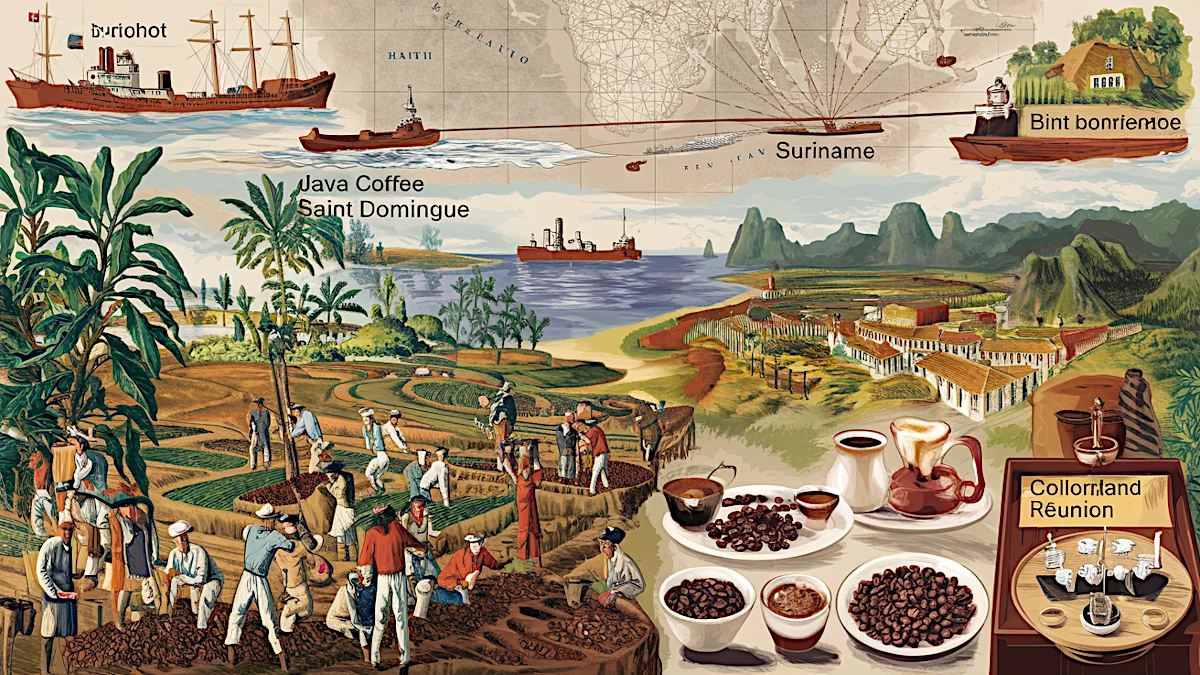
Coffee is grown in tropical regions across the globe, with leading producers such as Brazil, Colombia, Ethiopia, and Vietnam shaping the modern coffee trade. However, coffee’s journey to becoming a global commodity was far from simple. Influenced by colonial trade, powerful entities like the Dutch East India Company, and the exploitation of labor, the history of coffee trade is a testament to the interplay of commerce, culture, and innovation.
This article will uncover the rich history of the coffee trade, explore key moments in its evolution, and answer the question: Where is coffee grown today?
Table of Contents
The Beginnings of Coffee Cultivation in Arabia
Origins of Coffee in the Arabian Peninsula
The story of coffee begins in Ethiopia, where legend credits a goat herder named Kaldi with discovering coffee beans. By the 15th century, coffee cultivation had spread to Yemen, where it thrived under the care of Sufi communities. These mystics used coffee during religious rituals for its stimulating properties, spreading its popularity across the Arabian Peninsula.
Arabia became the world’s first coffee trading hub, with ports like Mocha exporting the prized beans to regions as far as the Ottoman Empire and Europe.
The Coffee Trade and Religious Influence
The Islamic world played a crucial role in the early coffee trade. Coffee houses, or qahveh khaneh, became centers for social and intellectual gatherings, earning coffee the nickname “wine of Islam.” The religious and cultural importance of coffee paved the way for its trade to flourish, connecting Arabia to the wider world.
Coffee as a European Commodity
The Role of European Powers in Coffee Trade
By the 17th century, European powers recognized coffee’s potential as a lucrative commodity. The Dutch were among the first to break Arabia’s monopoly on coffee. They transported coffee plants to their colonies, introducing the crop to Java and establishing large-scale plantations.
The Dutch East India Company and the Globalization of Coffee
The Dutch East India Company (VOC) was pivotal in transforming coffee from a regional crop into a global commodity. By 1696, the VOC had initiated coffee cultivation in Java using seeds from India. Java soon became a major coffee supplier, and by 1711, Amsterdam had emerged as the hub of the European coffee trade.
Colonialism and the Rise of Coffee Plantations
The Expansion of Coffee Cultivation in Colonial Territories
During the 18th century, colonial powers like France, Britain, and Spain expanded coffee cultivation to the Caribbean, South America, and Southeast Asia. These regions’ tropical climates were ideal for coffee growth, and coffee plantations flourished.
Enslaved Labor and the Dark Side of the Coffee Trade
Unfortunately, this expansion was fueled by the exploitation of enslaved labor. In colonies like Haiti and Jamaica, enslaved workers toiled under harsh conditions to meet Europe’s growing demand for coffee. While these plantations enriched colonial empires, they left a dark legacy of human suffering.
The Decline of Caribbean Coffee and the Shift to the Americas
The Haitian Revolution and Its Impact
The late 18th century saw the rise of the Haitian Revolution, which led to the collapse of Caribbean coffee production. Once the world’s leading coffee producer, Haiti’s industry never recovered after the revolution.
Brazil and Colombia: New Powerhouses
With Caribbean coffee in decline, countries like Brazil and Colombia rose to prominence in the 19th century. Brazil’s vast lands and Colombia’s mountainous terrain proved ideal for coffee cultivation. Today, these nations are among the top coffee producers, shaping the modern international coffee trade.
The Industrialization of Coffee Production
Mechanization and Efficiency
The 20th century brought mechanized farming techniques, increasing efficiency in coffee production. Countries like Brazil led the way, using technology to scale up operations and meet growing demand.
Global Coffee Trade Today
Today, the global coffee trade spans nearly 70 countries, with producers like Ethiopia, Vietnam, and Colombia leading the way. Modern trends emphasize sustainability, fair trade, and ethical sourcing to address the challenges of climate change and labor exploitation.
Conclusion: The Enduring Legacy of the Coffee Trade
The history of coffee trade is a tale of resilience, innovation, and cultural exchange. From its humble origins in Ethiopia to its status as a global commodity, coffee has shaped economies, cultures, and societies.
As the world faces new challenges, including climate change and evolving consumer preferences, the coffee trade must continue to adapt. Yet, the legacy of this incredible beverage remains, uniting people across the globe—one cup at a time.